
From a single question to the finals stage.
Every RYSI journey starts with curiosity and ends in front of a jury of scientists. Here is the full path a project takes, stage by stage.
How to participate in Stage 2
A step-by-step guide to Stage 2, the national round, for students who have qualified.
From idea to finals
Reviewed by educators and scientists at every step.
- Step 1 · Register
Sign up & get used to the platform
Students register online - through their school or independently.
- Step 2 · Stage 1: Submit
Perform the given activity, follow the instructions & submit
Students build and carry out a hands-on experiment, record what they observe, and submit their project online - make and play with the activity, fill out an observation sheet, answer a quiz and submit those with photos and a short video.
- Step 3 · Stage 1: Review
Evaluation & qualifiers
Reviewers assess each submission within its category on scientific thinking, experimentation, reasoning, and communication. Qualifying students advance to Stage 2.
- Step 4 · Stage 2: Innovate
Make up to two submissions on any topic(s) of your choice in the Grade I-X national curriculum.
Stage 2 asks qualifiers to innovate and make submissions of their choice. This round determines who is invited to the national finals as a finalist.
- Step 5 · Finals: Present
Present to the jury
Finalists travel to the national finals, present their work live and answer questions from a jury of scientists and educators, alongside an exhibition of projects.
- Step 6 · Celebrate
Winners announced
Winners and runners-up are honoured in each category at the awards ceremony. All finalists are recognised for their work.
What is expected of a good Stage 2 entry?
A hands-on, experiential science activity that demonstrates a principle in any topic of your choice, occurring in III to X standard science curriculum. Working models, toys or experiments that help demonstrate the scientific principle are acceptable. Remember, you should choose an activity that demonstrates the scientific principle rather than one that is simply an application-type or engineering project. Static models and well-known common activities will also not attract a good score.
How can I win?
We are looking for the following in the innovations you submit:
- Originality of the idea
- Effectiveness with which it and the child conveys the chosen topic
- Ease of availability and cost of the materials used
- "Fun" - how much will a child enjoy the activity and how much was it explored?
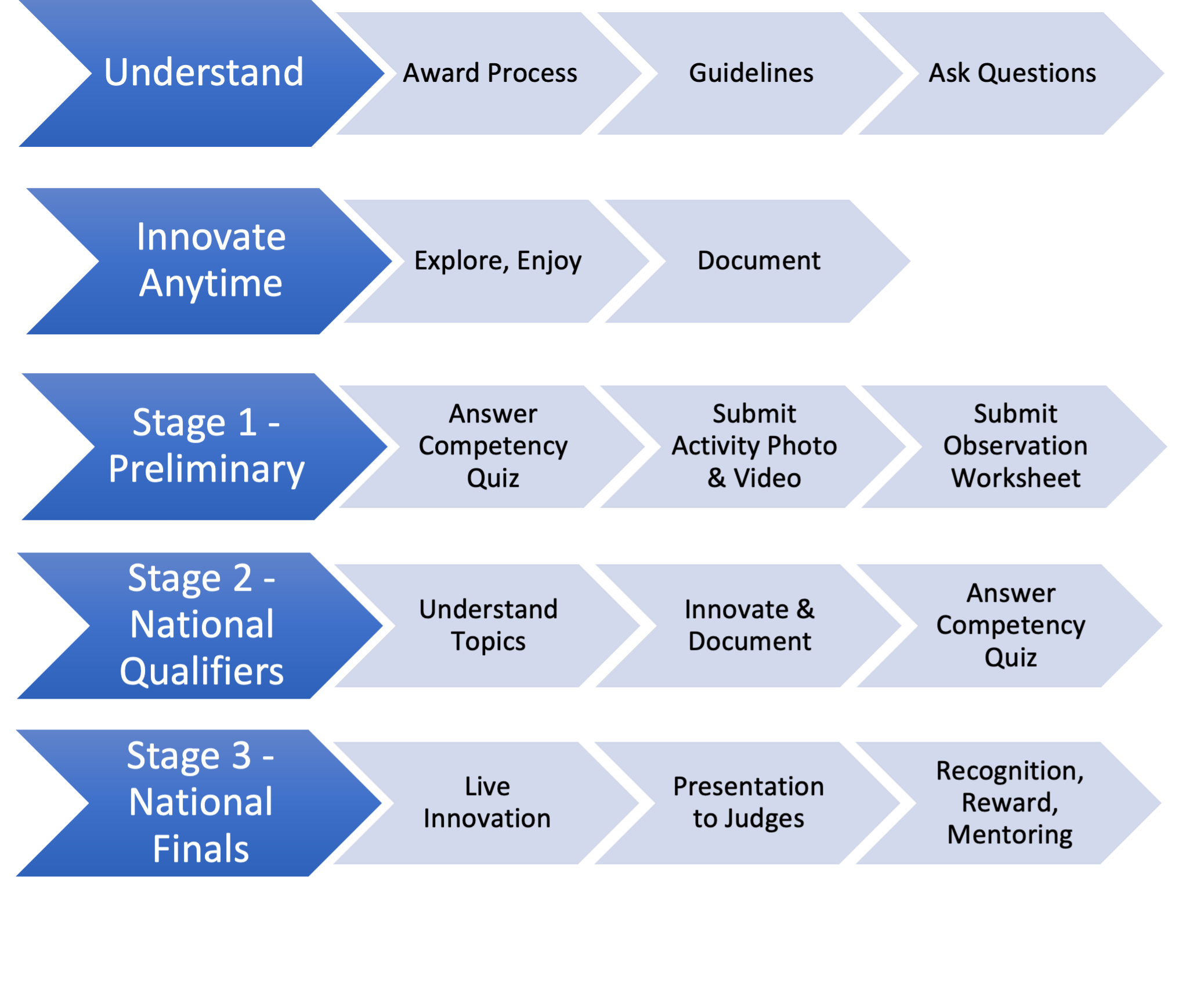
The process, in one picture
The official RYSI process flow for the current season.
What to expect along the way
Three things that make the journey approachable for first-time participants.
It is online until the finals
Registration, submission and the first stages all happen online, so students can take part from anywhere in India. Only finalists travel for the live finals.
Every entry is reviewed
Submissions are evaluated within their grade category, so younger students are never measured against older ones.
Start the journey
It begins with a single question worth investigating.